Products:-

By 1899, Royal Enfield were producing a quadricycle – a bicycle modified by adding a wrap-around four-wheeled frame, retaining a rear rider-saddle with handlebars – having a front-mounted passenger seat, driven by a rear-mounted De Dion engine.
After experimenting with a heavy bicycle frame fitted with a Minerva engine clamped to the front downtube, Enfield built their first motorcycle in 1901 with a 239 cc engine.1907 Enfield 15
A light car was introduced in 1903 powered by either a French Ader V-twin or De Dion single cylinder engine. In 1906 car production was transferred to a new company, the Enfield Autocar Co Ltd with premises in Hunt End, Redditch. The independent company only lasted until 1908 when it was purchased by Alldays & Onions.
In 1907, Enfield merged with the Alldays & Onions Pneumatic Engineering Co. of Birmingham, and began manufacturing the Enfield-Allday automobile.
By 1910, Royal Enfield was using direct belt drive 297 cc Swiss Motosacoche V-Twin engines which were enlarged to 344cc for 1911 with the advent of chain drive and the Enfield 2 speed gear. Enfield hired Bert Colver from Matchless and competed in the 1911 Isle of Man lightweight TT.1913 Enfield 425cc
In 1912, the Royal Enfield Model 180 sidecar combination was introduced with a 770 cc V-twin JAP engine which was raced successfully in the Isle of Man TT and at Brooklands. Enfield developed a prototype for the soon to arrive 1913 425cc model 140. The prototype was Enfield’s first in house manufactured V twin, also at 344cc, being of overhead inlet, side exhaust layout.
First World War (1914–1918):-

In 1914 Enfield supplied large numbers of motorcycles to the British War Department and also won a motorcycle contract for the Imperial Russian Government. Enfield used its own 225 cc two-stroke single and 425 cc V-twin engines.They also produced an 8 hp motorcycle sidecar model fitted with a Vickers machine gun.
Inter-war years (1921–1939):-
In 1921, Enfield developed a new 976 cc twin, and in 1924 launched the first Enfield four-stroke 350 cc single using a Prestwich Industries engine. In 1928, Royal Enfield began using the bulbous ‘saddle’ tanks and centre-spring girder front forks, one of the first companies to do so. Even though it was trading at a loss in the depression years of the 1930s, the company was able to rely on reserves to keep going. In 1931, Albert Eadie, one of the founders of the company, died and his partner R.W. Smith died soon afterwards in 1933.
Second World War (1939–1945):-
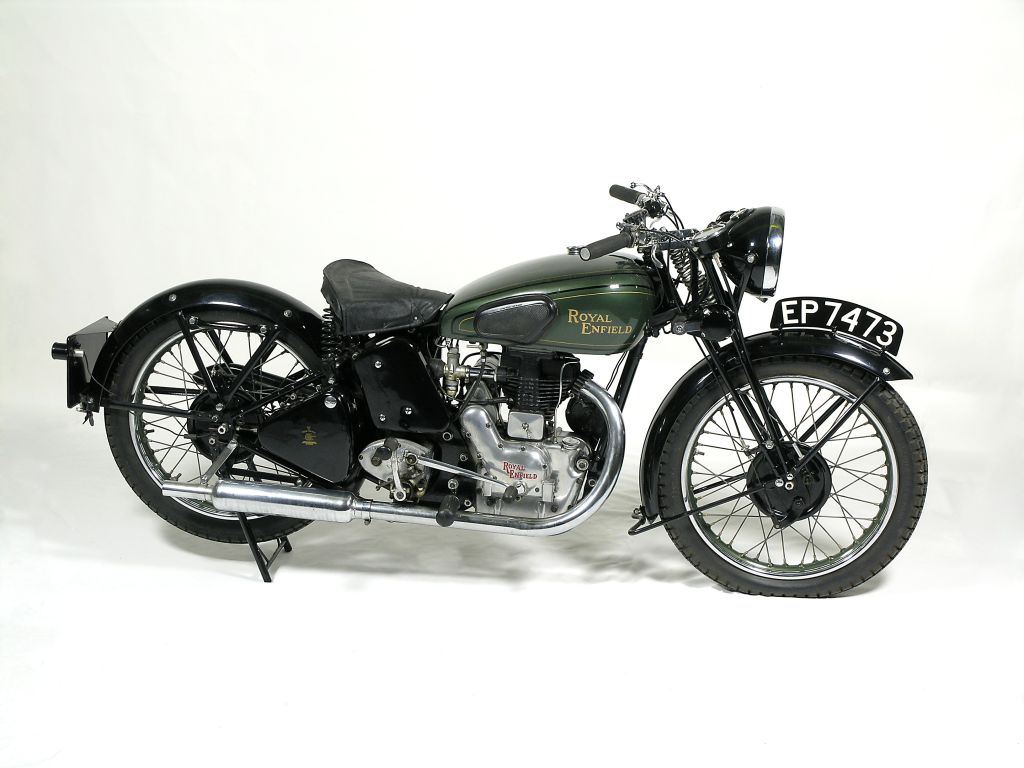
Royal Enfield 250 cc, type 11F
During World War II, The Enfield Cycle Company was called upon by the British authorities to develop and manufacture military motorcycles. The models produced for the military were the WD/C 350 cc sidevalve, WD/CO 350 cc OHV, WD/D 250 cc SV, WD/G 350 cc OHV and WD/L 570 cc SV. One of the most well-known Enfields was the Royal Enfield WD/RE, designed to be dropped by parachute with airborne troops.
In order to establish a facility not vulnerable to the wartime bombing of the Midlands, an underground factory was set up, starting in 1942, in a disused Bath stone quarry at Westwood, near Bradford-on-Avon, Wiltshire. Many staff were transferred from Redditch and an estate of “prefabs” was built in Westwood to house them.
As well as motorcycle manufacture, it built other equipment for the war effort such as mechanical “predictors” for anti-aircraft gunnery: the manufacture of such high precision equipment was helped by the constant temperature underground. After the war the factory continued, concentrating on engine manufacture and high precision machining. After production of Royal Enfield motorcycles ceased, the precision engineering activities continued until the final demise of the company.
 Site Title

_(cropped).jpg)


.jpg)